West Kent Local News
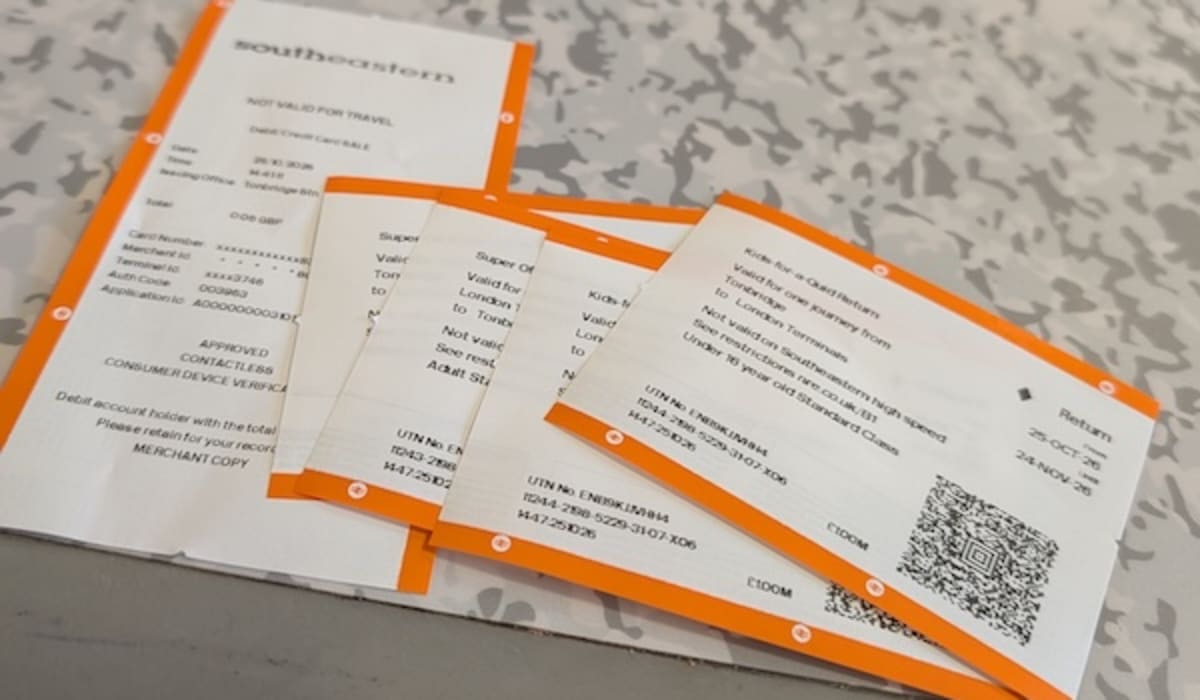
A new barcode ticket bought at Tonbridge station, part of Southeastern's switch to QR-coded paper-roll tickets. Image credit: reader submission.
Why Your Train Ticket Looks Different Now - and Why the Rail Industry Can't Agree on Paper vs Phone
Has your train ticket started feeling different lately? Thinner paper. A barcode where the stripe used to be. One West Kent reader noticed it travelling from Tonbridge - but this isn't a Tonbridge thing. It's happening at stations across Maidstone, Sevenoaks, Tunbridge Wells and Tonbridge & Malling, because it's a nationwide Southeastern change.
And it's only half the story. The government is spending money on two things at once that pull in different directions - making digital ticketing easier, and making sure it can't be used to dodge fares.
What's actually changing
Southeastern is spending £9 million replacing over 200 ticket machines. Some of the old ones have been in service for more than 20 years.
The new machines print barcode tickets on paper rolls, instead of the old card-stock tickets. They'll also offer contactless payment, Oyster top-up, and accessibility upgrades like high-contrast screens.
David Wornham, Southeastern's Customer Experience Director, put it like this: “Technology has moved on significantly and customers rightly expect a more modern experience.”
The first new machines aren't due at stations until around the new year. So the barcode ticket you've already got? That's most likely Southeastern's existing eTicket - emailed, printed or shown on a phone - not a brand new machine arriving early. The flimsier paper is getting to passengers before the new hardware is.
Three numbers that explain the tension
Southeastern's new ticket machines£9m
New anti-fare-evasion ticket gates (DfT, England-wide)£33.4m
Fare evasion's estimated annual cost to the railwayup to £400m
Bars scaled to £400m. Sources: Southeastern; Department for Transport press releases, 15 July and 7 August 2026.
Fare evasion is the much bigger money problem - by a wide margin. That's why the Department for Transport is funding two things at once that can look like they're pulling in opposite directions.
Chasing convenience and fraud at the same time
On one side, the DfT has been trialling pay-as-you-go ticket apps since 2025 - phone and GPS only, no machine needed. Those trials were extended to September 2027 and opened to everyone in August, after more than 30,000 journeys on just two routes.
The DfT has separately been rolling out contactless pay-as-you-go more widely across south-east England, most recently adding 50 more stations in Essex, Hertfordshire and Surrey from December 2025 - though none of those are Southeastern stations, so it hasn't reached West Kent yet. The department says passengers using the scheme elsewhere in the south-east have already made 5.6 million journeys with it since June 2024.
Rail Minister Lord Peter Hendy said the trials show “a simpler and smarter way to travel ahead of the creation of Great British Railways.”
On the other side, the same department announced £33.4 million for new ticket gates at what it calls “fare dodger hotspots” across England, specifically to recover some of that estimated £400 million lost to fare evasion every year. The new gates aren't anti-digital, though - the DfT says they'll support scanning a digital ticket, inserting a paper one, or tapping out with contactless, all at the same barrier.
Rail Minister Lord Peter Hendy said: “Fare evasion is not a victimless crime - it undermines confidence in the railway and means passengers lose out on millions in revenue, which should be invested to improve services for everyone.”
So which way is it actually going?
Both, at once - deliberately. The government is simultaneously expanding digital ticketing, because it's cheaper and more convenient, and investing in physical gates to make sure that same digital convenience doesn't just make fare-dodging easier.
Southeastern's new machines sit right in the middle of that: more barcode tickets, yes - but still printed on paper, with a human-staffed ticket office kept alongside them, not a straight swap for phones. For West Kent commuters, in Maidstone, Sevenoaks, Tunbridge Wells and Tonbridge & Malling alike, that flimsier ticket in your pocket isn't a step toward no paper at all. It's one piece of a much larger, still-unsettled rebuild of how the railway sells and checks tickets.
Source: Southeastern, Department for Transport, £33.4 million to fund new gateline improvements, Department for Transport, digital PAYG trial extension (Yorkshire/East Midlands) and Department for Transport, contactless PAYG expansion across the south-east. Contains public sector information licensed under the Open Government Licence v3.0.